Wondering when to replace your AC in Mohave Valley? Real cost breakdowns, warning signs, and what desert homeowners need to know before investing in a new system.
Replacing an air conditioner in Mohave Valley isn’t a casual purchase — it’s a $5,000–$12,000 decision that determines your comfort and electric bill for the next decade. This guide gives you the real numbers, the warning signs that mean it’s time, and what to expect if you pull the trigger on a new system.
Five Signs Your AC Is Dying (Not Just Having a Bad Day)
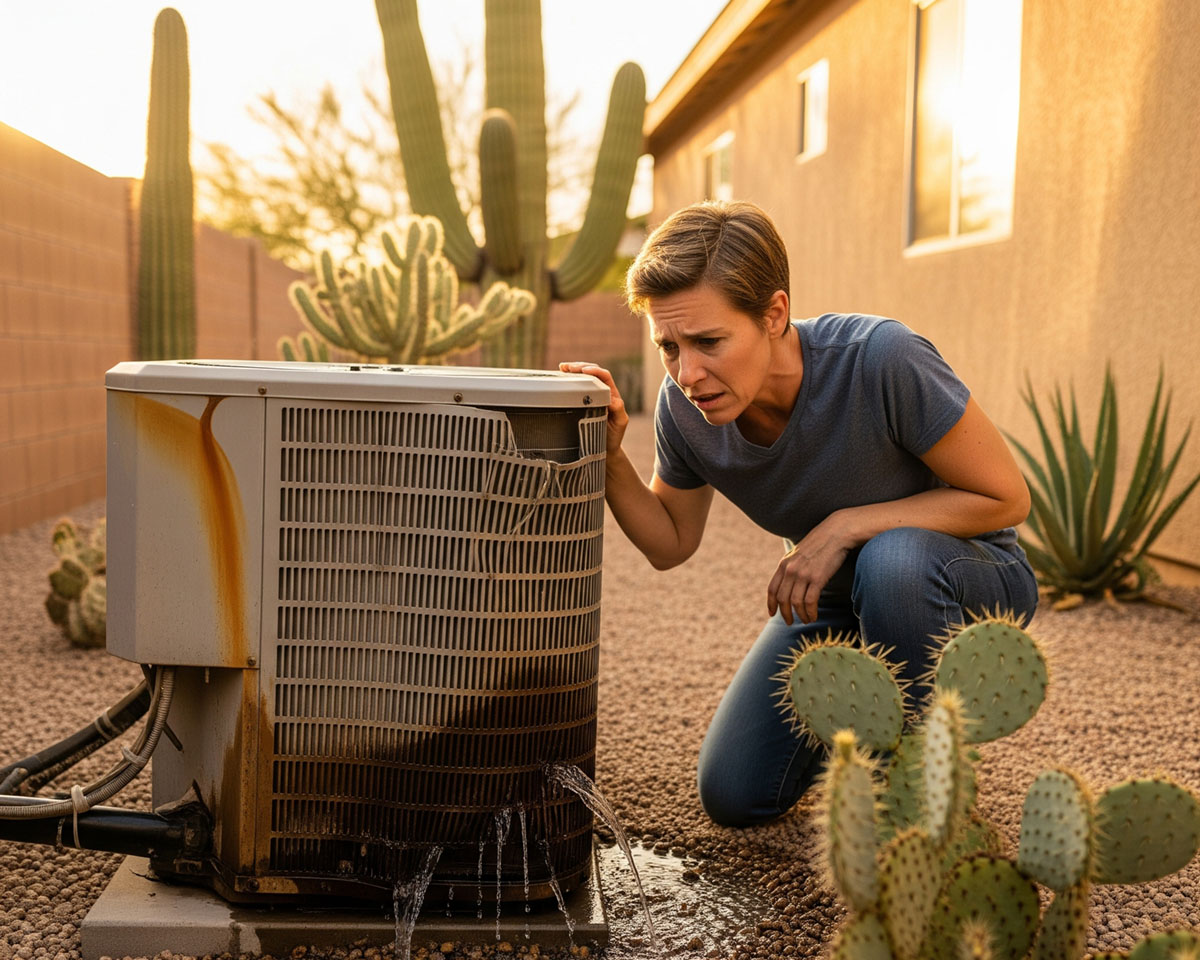
Every AC has off days. But these patterns signal a unit that’s approaching end-of-life — not one that needs a $200 fix:
- Rising electric bills with the same usage. If your July bill jumped from $280 to $350 year-over-year and your habits haven’t changed, your system is losing efficiency. Compressors draw more power as they wear, and duct leaks worsen over time.
- Repairs are getting frequent. One repair per summer is normal. Two or three in the same season? Your system is telling you something. Track your repair invoices — if you’ve spent $1,500+ in the last two years, you’re financing a replacement in installments.
- Uneven cooling room to room. The master bedroom is 72°F, the guest room is 82°F. This usually means your system can no longer push enough airflow. Could be ductwork, but in an older system it’s often a weakening blower motor or undersized unit that was never right for the house.
- Your unit is 10–12 years old. National average AC lifespan is 15–20 years. In the Mohave Desert, where your system runs 7+ months per year at extreme load, realistic lifespan drops to 10–14 years. At 12+, every repair is a gamble.
- It uses R-22 refrigerant. R-22 (Freon) was phased out in 2020. If your system still runs on it, a single recharge now costs $90–$150 per pound — and a typical charge needs 5–10 pounds. That’s $450–$1,500 just for refrigerant, on a system that’s already outdated.
What a New AC System Actually Costs in the Tri-State Area
National cost estimates are useless here — Mohave Valley has different equipment needs than Phoenix or Tucson. Here’s what local homeowners typically pay:
| System Type | Capacity | Equipment | Installation | Total Installed |
|---|---|---|---|---|
| Entry-level split system | 2.5–3 ton | $2,500–$3,500 | $2,000–$3,000 | $4,500–$6,500 |
| Mid-range split system | 3–4 ton | $3,500–$5,000 | $2,500–$3,500 | $6,000–$8,500 |
| High-efficiency / variable speed | 3–5 ton | $5,000–$7,500 | $3,000–$4,500 | $8,000–$12,000 |
| Heat pump (dual heating/cooling) | 3–4 ton | $4,000–$6,000 | $2,500–$4,000 | $6,500–$10,000 |
Desert-specific sizing note: Most Mohave Valley homes between 1,400–2,200 sq ft need a 3.5–5 ton system. Undersizing is the most common installation mistake — a 3-ton unit in a 2,000 sq ft home with west-facing windows will run non-stop in July and still not hold temperature. A proper Manual J load calculation should be part of any professional installation quote.
If upfront cost is a concern, ask about financing options — most quality contractors offer 0% or low-interest plans for qualifying homeowners.
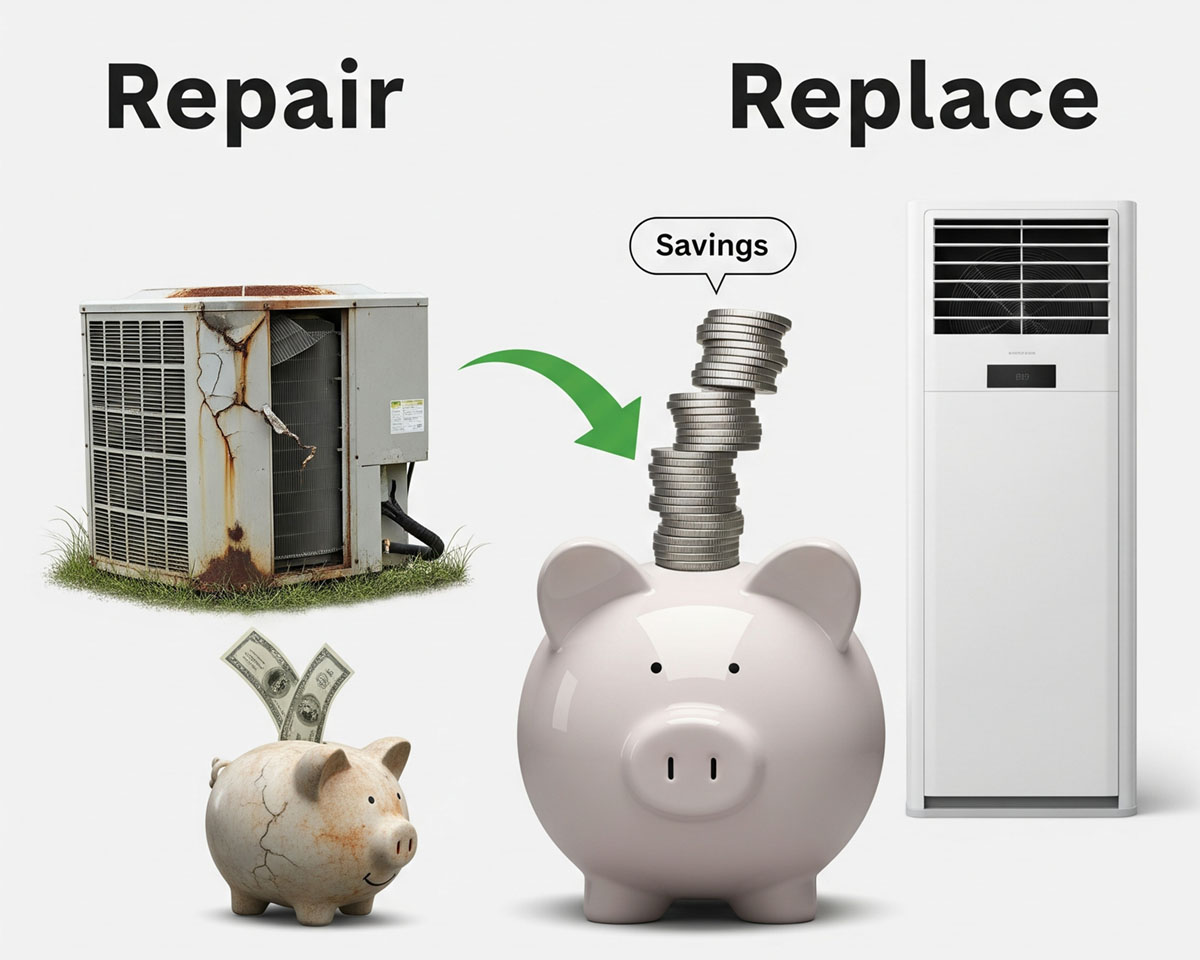
The 50% Rule: Repair vs. Replace Math
Here’s the simplest decision framework in HVAC:
If a single repair costs more than 50% of a new system — replace it.
Example: Your 11-year-old 3-ton unit needs a $1,800 compressor replacement. A new mid-range system installed costs $7,000. That repair is 26% of new — still worth fixing if the rest of the unit is sound. But add the $450 you spent on a capacitor in March and the $300 fan motor last September, and you’re at $2,550 — 36% of new on an aging system. The math is tilting.
Factor in the efficiency gap: a 2013 unit might run at 14 SEER. A 2024 system starts at 15 SEER (the federal minimum for southern states) and popular models hit 17–20 SEER. On a $300/month summer electric bill, a jump from 14 to 18 SEER saves roughly $65/month — $390 over a cooling season. Over 10 years, that’s $3,900 in energy savings alone.
What Happens on Installation Day
A professional AC installation in Mohave Valley typically takes 4–8 hours for a standard split system swap, or 1–2 days if ductwork modifications are needed. Here’s the general sequence:
- Pre-installation site visit (usually a separate day). The tech measures your home, checks ductwork, evaluates electrical capacity, and runs a load calculation. This is where sizing decisions happen.
- Old system removal. Refrigerant is recovered (legally required), the old condenser and evaporator coil are disconnected and removed.
- New equipment placement. Condenser pad leveled outside, new evaporator coil positioned inside, refrigerant lines brazed and pressure-tested.
- Electrical and thermostat. Dedicated circuit verified, new disconnect installed if needed, thermostat wired and programmed.
- Commissioning. Refrigerant charge verified by weight and superheat/subcooling. Airflow measured at registers. System cycled through heating and cooling modes.
For a detailed hour-by-hour walkthrough of the installation process, including what to prepare beforehand, see our guide to AC installation in Bullhead City — the process is identical across the Tri-State area.
How to Choose Your Installation Contractor
This is where most homeowners make their biggest mistake: choosing on price alone. In Arizona, verify three things before signing anything:
- Active ROC license (CR-39 classification). Check at roc.az.gov. No license = no legal recourse if something goes wrong, and your manufacturer warranty may be void.
- Written load calculation. If a contractor quotes a system size without measuring your home, they’re guessing. Oversizing causes short-cycling (humidity problems); undersizing means your system never catches up on the hottest days.
- Itemized written quote. Equipment model numbers, labor, permits, warranty terms, and what’s included (thermostat? ductwork? pad?). “Approximately $7,000” is not a quote.
For a deeper checklist on vetting HVAC contractors in this area, our Mohave County HVAC contractor guide covers the full process including what questions to ask and red flags to watch for.
Desert-Specific Installation Considerations
Mohave Valley isn’t Phoenix. Our specific climate challenges affect installation decisions:
- Extreme heat load. Design temperature in Mohave Valley is 115°F+. Systems must be rated for continuous operation at these temperatures — not all units are. Check the manufacturer’s maximum operating temperature spec.
- Dust and debris. Desert dust, monsoon mud, and cottonwood fluff clog condenser fins fast. Consider a unit with easy-clean coil access and a hose-down-friendly design position.
- UV degradation. Direct sun on your condenser reduces its lifespan. A shade structure (approved by the manufacturer — don’t block airflow) can extend condenser life by 2–3 years.
- Monsoon surge protection. Lightning and power surges during monsoon season kill capacitors and control boards. A whole-home surge protector ($200–$400 installed) pays for itself after one saved repair.
Maintaining Your New System to Maximize Lifespan
A $8,000 system that lasts 8 years because of neglect costs $1,000/year. The same system maintained properly for 14 years costs $571/year. Maintenance is the difference.
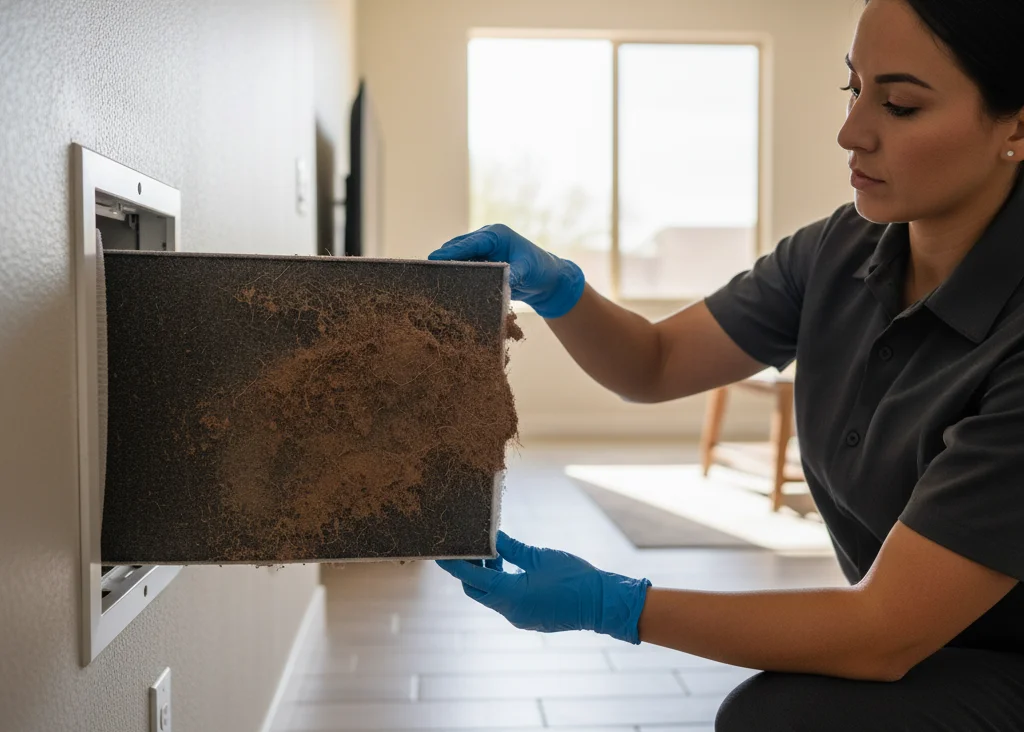
- Monthly filter changes April–October. This is non-negotiable in the desert. Your system’s biggest enemy is restricted airflow from dust-loaded filters.
- Annual professional maintenance tune-up each spring. Refrigerant check, electrical connection tightening, coil cleaning, and moving-part inspection.
- Quarterly condenser rinse. Garden hose, gentle spray from inside out. Takes 10 minutes. Removes dust and debris from fins.
Our year-round HVAC maintenance calendar has month-by-month tasks specific to desert homeowners.
Need Help With This Today?
Use the quick actions below to get answers, book the right service, or talk directly with Horizon Air before the issue gets more expensive.
Frequently Asked Questions
Quick answers for the questions homeowners ask right before they call, schedule, or compare their next move.
How long does an AC installation take in Mohave Valley?
A standard split system replacement (same location, existing ductwork) takes 4–8 hours. If ductwork modifications, electrical upgrades, or a full system relocation is needed, expect 1–2 full days. Most installations are completed in a single day.
What size AC do I need for my Mohave Valley home?
Most homes in the area between 1,400–2,200 square feet require a 3.5–5 ton system, but the only accurate answer comes from a Manual J load calculation that factors in your home’s insulation, window orientation, ceiling height, and ductwork condition. Never accept a size recommendation based only on square footage — it ignores critical variables.
Are there rebates available for new AC installation in Arizona?
Arizona utility providers including Mohave Electric Cooperative and UniSource Energy Services periodically offer rebates for high-efficiency HVAC equipment (typically 16 SEER and above). Federal tax credits under the Inflation Reduction Act provide up to $2,000 for qualifying heat pump installations. Ask your contractor about current programs — they change annually.
Next Helpful Reads
Pick the next guide that matches the reader’s decision stage so the flow feels helpful instead of dumped.
Horizon Air, LLC