AC maintenance in Mohave Valley pays back in under one year. See the exact cost, savings math, and five questions that tell you whether to book an inspection now.
Skipping AC maintenance in Mohave Valley costs most homeowners between $300 and $600 per year in wasted electricity — before factoring in repairs. According to ENERGY STAR, a neglected air conditioner uses up to 15 percent more energy than a properly maintained system. On a $300 summer power bill, that is $45 extra every month across a seven-month cooling season. This guide covers the financial case for acting now: exact cost ranges, payback math, and a five-question self-diagnostic that tells you whether your system qualifies for maintenance or needs something more.
What Deferred AC Maintenance Costs Mohave Valley Homeowners Each Year
Mohave County summer power bills run high. Residential customers in Bullhead City and Fort Mohave averaging $250 to $400 per month during peak cooling season are common, with bills climbing above $500 during haboob months when systems run nonstop. A system losing 15 percent efficiency from deferred maintenance adds $37 to $60 to every monthly bill.
The annual cost of that deferred maintenance, translated to real Mohave County numbers:
| Monthly bill baseline | Efficiency loss (15%) | Monthly overage | 7-month season total |
|---|---|---|---|
| $250 | $37 | $37 | $259 |
| $300 | $45 | $45 | $315 |
| $400 | $60 | $60 | $420 |
Over five years at a $300 baseline, a homeowner running a neglected system pays $1,575 more in electricity than a neighbor with an identical unit that receives annual maintenance. That figure does not include the increased repair probability. Industry data consistently shows that poorly maintained systems fail at significantly higher rates during peak demand — exactly when Mohave Valley summer heat makes a breakdown most costly to resolve.
Arizona makes this math worse than the national average. A system that loses efficiency gradually over 15 years nationally completes the same degradation cycle in 7 to 10 years in Mohave County because of longer run seasons, extreme heat loads, and desert particulate accumulation. National maintenance schedules underestimate this pace by a significant margin.
Why Arizona's Climate Degrades AC Systems Faster Than the National Average
Three conditions specific to Mohave County accelerate the efficiency and reliability decline that makes ac maintenance mohave valley homeowners should schedule annually more urgent than what standard national guidance recommends.
Attic heat loading — Unconditioned attic spaces in Mohave County reach 150°F to 160°F during July and August. Ductwork running through those spaces loses significant cooling capacity through conduction before conditioned air reaches living areas. Insulation degrades faster under sustained extreme heat, compounding losses year over year. A system working against attic heat loading runs longer cycles, accumulates more run-hours, and wears components faster than identical equipment in a moderate climate.
Monsoon humidity cycling — Mohave Valley receives concentrated monsoon moisture between July and September. Rapid swings from dry desert air to high humidity cause evaporator coil surfaces to alternate between moisture accumulation and dry-out cycles. This cycling promotes biofilm and mineral deposit buildup that restricts airflow and reduces heat-transfer efficiency. A coil surface degraded by monsoon cycling forces the compressor to run harder to reach setpoint temperatures, shortening its rated lifespan.
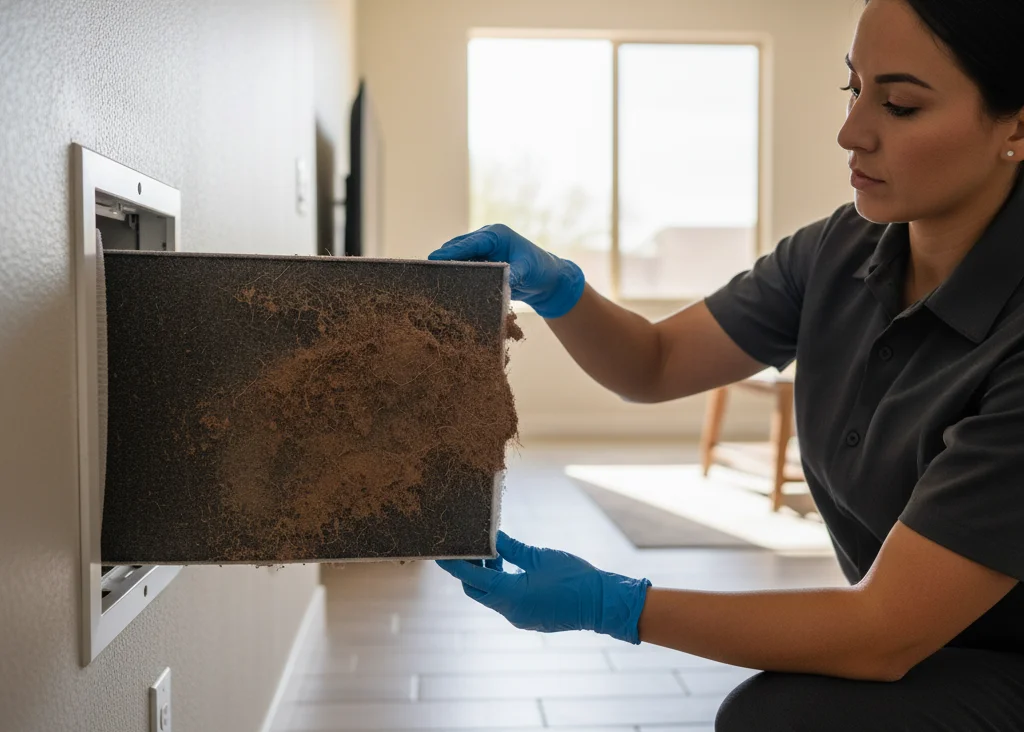
Desert dust and particulate load — Mohave County’s fine silica dust infiltrates filter media faster than pollen or urban particulates common in moderate climates. A filter rated for 90-day replacement intervals in a national standard reaches capacity in 30 to 45 days during haboob season. Dust past a clogged filter coats evaporator coil fins, reduces airflow at the blower, and embeds in motor bearings. The cumulative effect of sustained dust loading shortens the expected service life of key components by years compared to identical equipment in lower-particulate environments.
How to Know If AC Maintenance Is Worth It for Your Home Right Now
These five questions help you determine whether your system is a strong candidate for maintenance or whether the conversation should start with a replacement evaluation. If your answers point toward replacement rather than maintenance, our Fort Mohave guide to AC repair vs. replacement works through that decision step by step with local cost numbers.
1. Is your system more than eight years old? AC systems in Arizona experience accelerated wear due to longer run seasons and extreme heat. A system past eight years is entering the range where maintenance delivers the highest payback — components are still serviceable but beginning to accumulate wear that professional inspection can catch before failure.
2. Has your summer electricity bill increased 10 percent or more over the past two years without a rate change? A steady bill increase with no rate change is the clearest financial signal that system efficiency is declining. Even a 10 percent increase on a $300 monthly baseline costs $252 per season — enough to pay for professional maintenance several times over.
3. Does your system take longer than 20 minutes to cool the home by 5 degrees on days above 105°F? Extended run-cycles without reaching setpoint indicate restricted airflow, refrigerant loss, or compressor wear — all conditions a professional inspection identifies and quantifies.
4. Have you skipped maintenance for two or more years? Coil surfaces, drain lines, and electrical connections degrade on a schedule regardless of how the system appears from the outside. Two or more missed maintenance cycles means accumulated deposits and wear that significantly increase failure probability during peak summer demand.
5. Has anyone opened the ductwork, added a room, or changed the system recently? Any change to the air distribution system — renovation work, room additions, equipment upgrades — creates potential for duct leakage, air balance problems, and filter bypass that maintenance inspection identifies. If your system is not cooling evenly room to room, this is the likely cause.
Two or more yes answers is a reasonable basis for booking a professional inspection before peak season demand arrives.
What a Professional AC Maintenance Inspection Covers
A professional AC maintenance inspection by Horizon Air follows a structured process that goes significantly beyond a filter change or visual walkthrough.
-
System baseline measurement — The technician measures supply and return air temperatures, static pressure, and airflow volume before any work begins. These readings establish what the system is actually delivering versus its rated capacity.
-
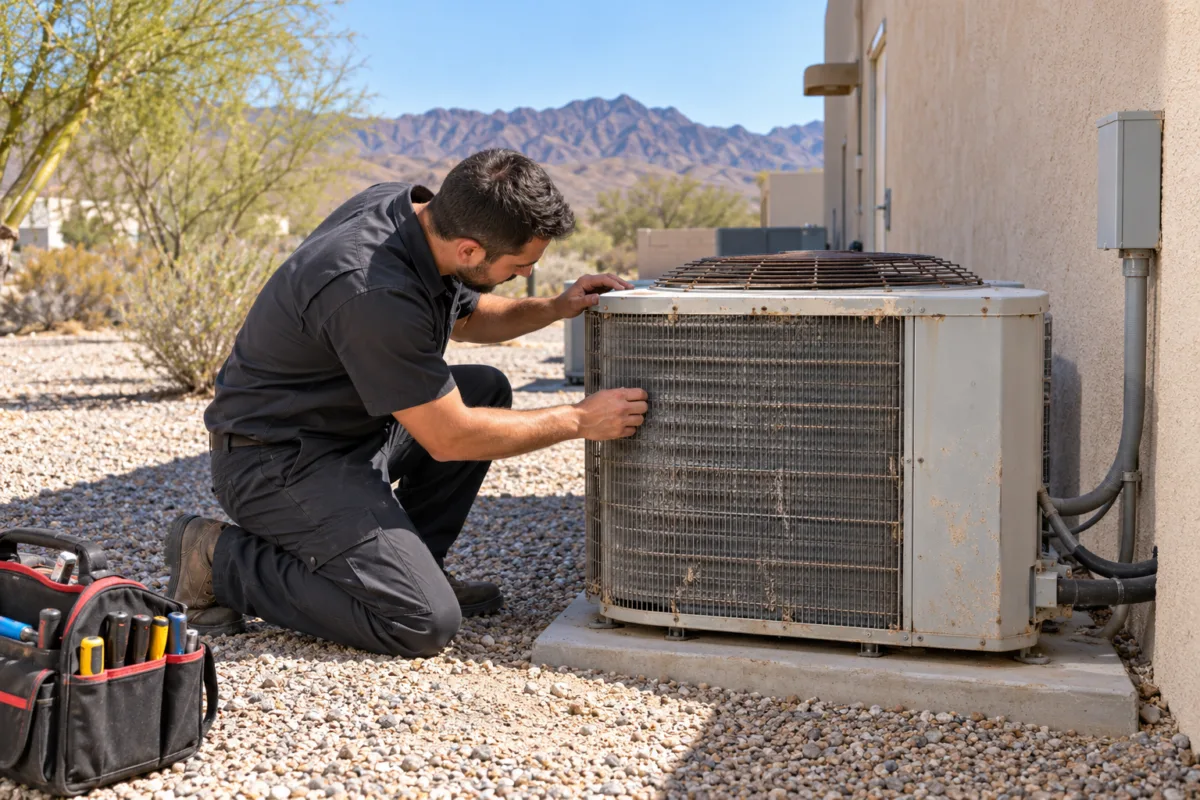
Mechanical inspection and cleaning — Evaporator coil and condenser coil cleaning, condensate drain flush, blower wheel inspection, and electrical connection tightening. Each of these tasks directly affects system efficiency and failure probability.
-
Refrigerant level verification — Refrigerant is checked against manufacturer specifications. Low refrigerant is a common and easily missed cause of reduced cooling capacity and compressor stress.
-
Component wear assessment — Capacitors, contactors, and motor bearings are tested against operating specifications. These parts fail predictably and give measurable warning signs before breakdown — a professional inspection catches them; reactive repair does not.
-
Post-service verification — After work is complete, the same temperature, pressure, and airflow measurements from step one are repeated to confirm the service delivered a measurable improvement.
Cost, Savings, and Payback: What Mohave Valley Homeowners Should Budget
A professional AC maintenance tune-up in the Mohave Valley market runs $129 to $179 for a standard residential system. Horizon Air’s VIP Comfort Club at $180 per year includes the spring tune-up plus repair discounts and priority scheduling through the cooling season — effectively paying for the tune-up cost plus providing ongoing protection.
The payback arithmetic for a $300 monthly baseline at 15 percent efficiency recovery:
- Monthly savings: $300 × 0.15 = $45
- Season savings (7 months): $315
- Payback period on a $150 tune-up: under 6 months
Utility rebate programs are available and reduce the net cost further. APS, MEC, and UniSource each offer efficiency incentive programs — verify current amounts directly with your utility, as program terms and funding caps change annually. The federal IRA Section 25C energy efficiency tax credit may also apply to qualifying HVAC maintenance and equipment work — consult a tax professional to confirm eligibility for your situation.
Call Horizon Air at 928-768-3761 or visit our cooling services page to verify current rebate eligibility for your system and utility. For a deeper look at what efficiency upgrades cost locally, see our energy efficiency guide for Mohave Valley.
How Regular Maintenance Protects Your HVAC System's Long-Term Lifespan
An air conditioner accumulates wear in proportion to its run-hours, not calendar years. In Mohave County, a residential system runs approximately 14 hours per day during peak season across a 7-month cooling season — roughly 2,940 run-hours per year. A system losing efficiency forces longer daily run-cycles to reach setpoint, compounding the annual run-hour total.
A 15 percent efficiency improvement from professional maintenance reduces the effective daily run-time needed to maintain the same interior temperature. Applied to the 2,940-hour baseline, that improvement reduces annual wear-hours by approximately 440 hours — the equivalent of removing 31 full days of operation from the compressor’s annual load.
Over ten years, this reduction accumulates to roughly 4,400 fewer compressor run-hours. Compressor lifespan is directly correlated with cumulative run-hours and thermal load — a compressor protected by annual maintenance has a meaningfully longer service life than an identical unit running without service in the same climate.
The financial frame: maintaining a $150-per-year service cadence protects a $5,000 to $10,000 equipment investment. The alternative — reactive repair when a component fails under peak load in July — typically costs three to five times more than the preventive service and delivers no long-term protection to the remaining equipment.
Frequently Asked Questions
Quick answers for the questions homeowners ask before they call or book.
How much does AC maintenance cost in Mohave Valley?
A professional AC tune-up in Mohave Valley runs $129 to $179 for a standard residential system. Horizon Air’s VIP Comfort Club at $180 per year bundles the tune-up with priority scheduling and repair discounts. Utility rebates from APS, MEC, or UniSource may reduce the net cost — verify current program amounts directly with your utility provider before scheduling.
Is AC maintenance worth it for Mohave Valley homes?
Yes, and the payback math makes the case directly. A $150 tune-up that recovers 15 percent efficiency on a $300 monthly summer bill saves $315 per season — a payback period of under six months. Mohave County’s 7-month cooling season and extreme heat conditions make the maintenance window shorter and the efficiency loss larger than national averages suggest.
How long does an AC maintenance inspection take in Arizona heat?
A professional residential inspection runs 60 to 90 minutes for a standard single-system home. Homes with two systems, complex ductwork, or equipment showing wear may require additional time for thorough measurement and documentation. The technician should provide post-service readings confirming the system improved before leaving the property.
Can I handle AC maintenance myself or do I need a professional?
Homeowners can safely replace filters on the correct schedule — every 30 to 45 days during haboob season, not the national 90-day standard — and clear debris from the condenser unit exterior. Coil cleaning, refrigerant verification, capacitor testing, and electrical connection inspection require licensed equipment and technician certification. DIY on those tasks creates warranty and safety risks.
Will AC maintenance lower my APS or MEC bill?
It typically does. The mechanism is direct: a cleaner coil transfers heat more efficiently, a properly charged refrigerant circuit runs shorter cycles, and a calibrated system reaches setpoint faster — all of which reduce electricity consumption. The savings amount depends on how degraded the system was before service. A system that has missed two or more maintenance cycles generally shows measurable bill improvement within the first full month after service.
How do I know if my AC needs maintenance or replacement in Mohave Valley?
Maintenance is the right starting point if your system is under 15 years old, cools the home eventually even if slowly, and shows no refrigerant loss after service. Replacement becomes the better financial decision when repair or maintenance costs exceed 50 percent of new equipment cost, when the system has required major repairs twice in two years, or when efficiency has declined to the point where annual savings no longer offset service costs. A professional inspection gives you the specific readings to make that comparison with actual numbers rather than estimates.
Horizon Air LLC has been serving Bullhead City, Fort Mohave, Mohave Valley, Kingman, and the surrounding Tri-State area since 1976. If you are ready to protect your system before peak summer demand arrives, call us at 928-768-3761. We are fully licensed under ROC #344248 and ready to deliver a professional inspection with documented before-and-after measurements. Contact us today to schedule your AC maintenance in Mohave Valley.
Horizon Air LLC